Homemade Sourdough Bread Starter: Easy Step-by-Step Guide for Perfect Artisan Loaves
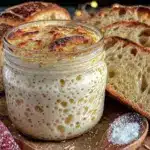
This homemade sourdough bread starter uses just flour and water to create a bubbly, tangy base for artisan loaves. With simple ingredients and a forgiving method, you’ll have a reliable starter for delicious, bakery-style bread.
- Prep Time: 5 minutes per day
- Cook Time: 0 minutes
- Total Time: 7 days
- Yield: 1 jar of starter (enough for multiple loaves) 1x
- Category: Bread
- Cuisine: American, European
Ingredients
Scale
- 50g (1/2 cup) unbleached all-purpose flour (King Arthur or Bob’s Red Mill recommended)
- 50g (1/2 cup) filtered or spring water
- Optional: 25-50g (about 1/4 cup) whole wheat or rye flour for Day 1
- Optional: 1 teaspoon local honey or a few organic grapes (for jumpstarting fermentation)
- Optional: 1:1 gluten-free flour blend (for gluten-free adaptation)
Instructions
- Day 1: Mix 50g (1/2 cup) unbleached all-purpose flour and 50g (1/4 cup) filtered water in a clean glass or ceramic jar. Optionally, use half whole wheat or rye flour for extra wild yeast. Stir until smooth, scrape down sides, cover loosely, and mark the level. Let sit at room temperature (68–75°F) for 24 hours.
- Day 2: Check for bubbles or a tangy smell. Discard half the starter (about 50g), then add 50g flour and 50g water. Stir, cover, and let rest for another 24 hours.
- Day 3: Look for bubbles and a slightly sour aroma. Repeat the discard and feeding: remove half, add 50g flour and 50g water, stir, cover, and rest 24 hours.
- Days 4–6: Continue the discard and feed process every 24 hours. If rising and falling predictably, feed twice daily for a stronger starter. By Day 5 or 6, the starter should double in size within 6–8 hours after feeding.
- Day 7: Starter should be bubbly, tangy, and double in size after feeding. Feed one more time, wait 4–6 hours, then use in your favorite sourdough bread recipe. Optional: Do the float test (drop a spoonful in water—if it floats, it’s ready).
- Maintenance: If baking daily, keep at room temperature and feed every 24 hours. For less frequent baking, store in the fridge and feed once a week.
Notes
Use unbleached flour for best results. If you miss a feeding, just resume as normal. If a dark liquid (hooch) forms, stir it in or pour off and feed. Starter gets stronger with each feeding. For gluten-free, use a blend with whole grains. Room temperature between 68°F and 75°F is ideal. Starter can be frozen for up to 3 months.
Nutrition
- Serving Size: 1 tablespoon (for nu
- Calories: 30
- Carbohydrates: 6
- Fiber: 0.5
- Protein: 1
Keywords: sourdough starter, homemade bread, artisan bread, wild yeast, fermentation, easy sourdough, bread baking, starter recipe, gluten-free sourdough, whole wheat starter